When most people shop for a smartphone, they naturally start with the price tag.
It’s an easy comparison to make. One phone costs a few hundred dollars, another costs several hundred more, and premium flagship devices can exceed $1,500.
On the surface, it seems like comparing prices is the simplest way to determine which phone offers the better deal.
But price and value are not the same thing.
The real question isn’t what a phone costs on day one; it’s what value that phone delivers over time.
A smartphone is something most people use every day for work, communication, learning, banking, entertainment, and increasingly, access to economic opportunities. When you look at it through that lens, the purchase becomes about much more than hardware specifications or storage capacity.
To better understand that difference, we compared several smartphones across both traditional device performance and the additional value users receive after purchase.
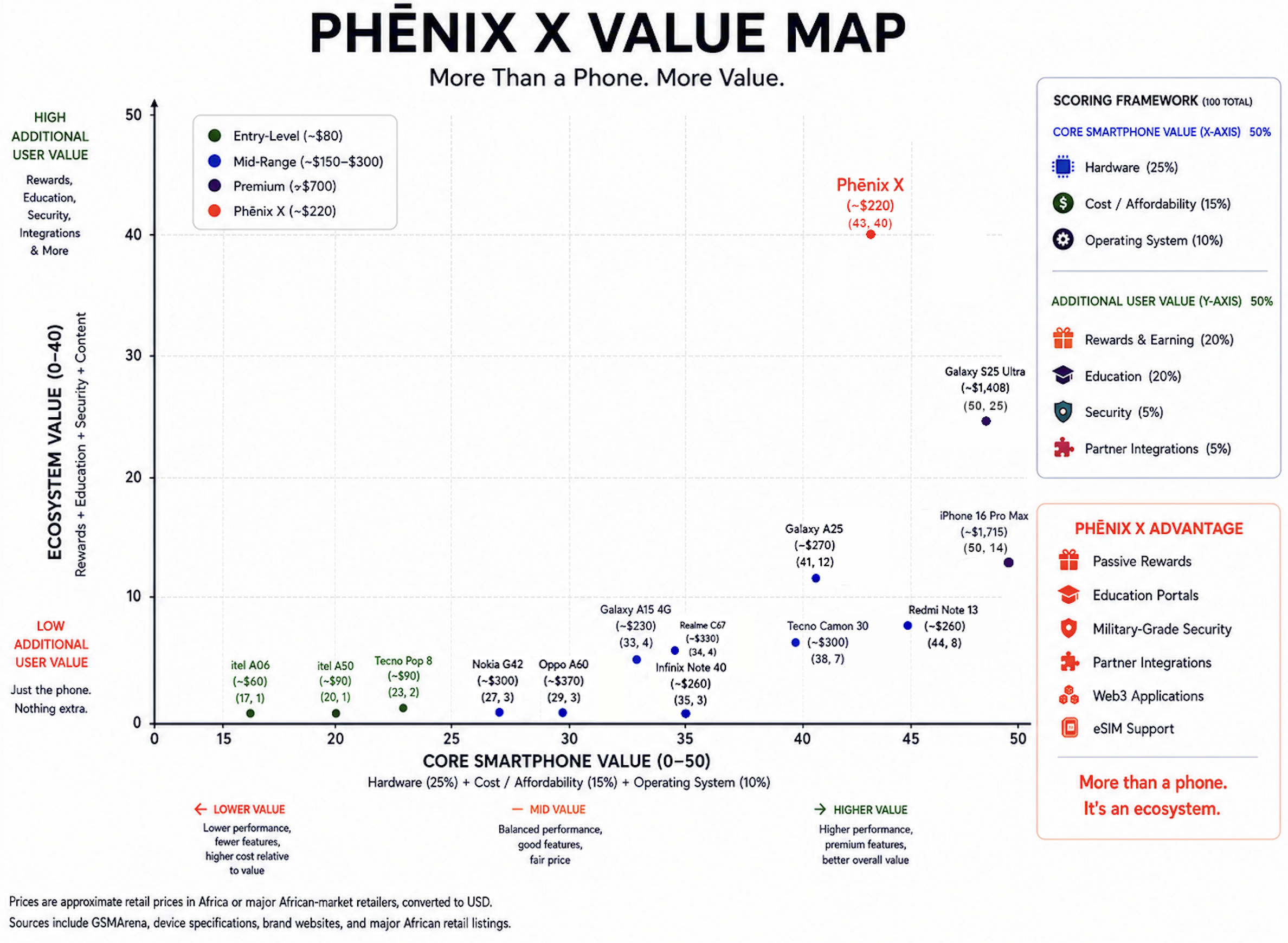
The comparison revealed something interesting. While many smartphones compete aggressively on hardware, very few offer meaningful value beyond the device itself.
Premium devices such as the iPhone 16 Pro Max and Samsung Galaxy S25 Ultra score highly on traditional smartphone features, but much of their value remains tied to the hardware experience.
Once the device is purchased, users often need to spend additional money on subscriptions, security services, learning platforms, or other tools to get more from their digital lives.
The Phēnix X takes a different approach.
Rather than focusing exclusively on hardware, the Phēnix X was designed around the idea that a smartphone should continue creating value long after it leaves the store.
At its core, the Phēnix X is a modern Android smartphone built for everyday use. It offers the features users expect from a contemporary device while providing access to a digital economy designed around security, education, rewards, and digital participation. Instead of treating the smartphone as the final product, the device serves as a gateway to additional tools and opportunities that many users would otherwise have to search for and manage separately.
Security
One significant difference is security. Today, many smartphone users purchase antivirus software, subscribe to VPN services, or pay for additional tools designed to protect their data and privacy online.
Those recurring costs can add up quickly over the life of a device. The Phēnix X was built with a security-first philosophy, providing users with access to a privacy-focused ecosystem designed to help safeguard personal information and support a safer digital experience without requiring multiple third-party subscriptions.
Rewards
The device also approaches ownership differently through its rewards ecosystem.
Traditionally, smartphones are a one-way expense. Users purchase a device and continue paying for services associated with it. The Phēnix X was built around the belief that a smartphone can create value for its owner over time.
Through the BitMobile ecosystem, users can access monthly rewards designed to provide ongoing benefits and help reduce the overall cost of ownership. While rewards may vary, the underlying concept remains simple: the device should continue giving back after the initial purchase.
Education
Education is another area where the Phēnix X stands apart.
Access to quality information and digital skills has become increasingly important in today’s economy, yet many educational resources remain fragmented or difficult to discover. Through the Phēnix ecosystem, users gain access to content focused on financial literacy, emerging technologies, digital skills, and personal development. Rather than requiring users to search across multiple platforms, the goal is to make valuable learning opportunities more accessible from within the ecosystem itself.
This broader approach is possible because the Phēnix X is more than a smartphone. It is currently the only blockchain-enabled smartphone commercially available across Africa.
For most users, that doesn’t mean they need to understand blockchain technology or become experts in digital assets. Instead, it means they gain access to a platform built around security, ownership, transparency, and participation in an increasingly digital world.
When comparing smartphones, it’s worth looking beyond specifications and asking a broader question: Does the device help you learn? Does it help protect you? Does it provide ongoing value? Does it create opportunities that extend beyond basic communication and entertainment?
For many smartphones, the answer is no. The Phēnix X was designed so that the answer can be yes.
That’s why the conversation isn’t really about price. It’s about value. And when viewed through that lens, the Phēnix X stands in a category of its own.